

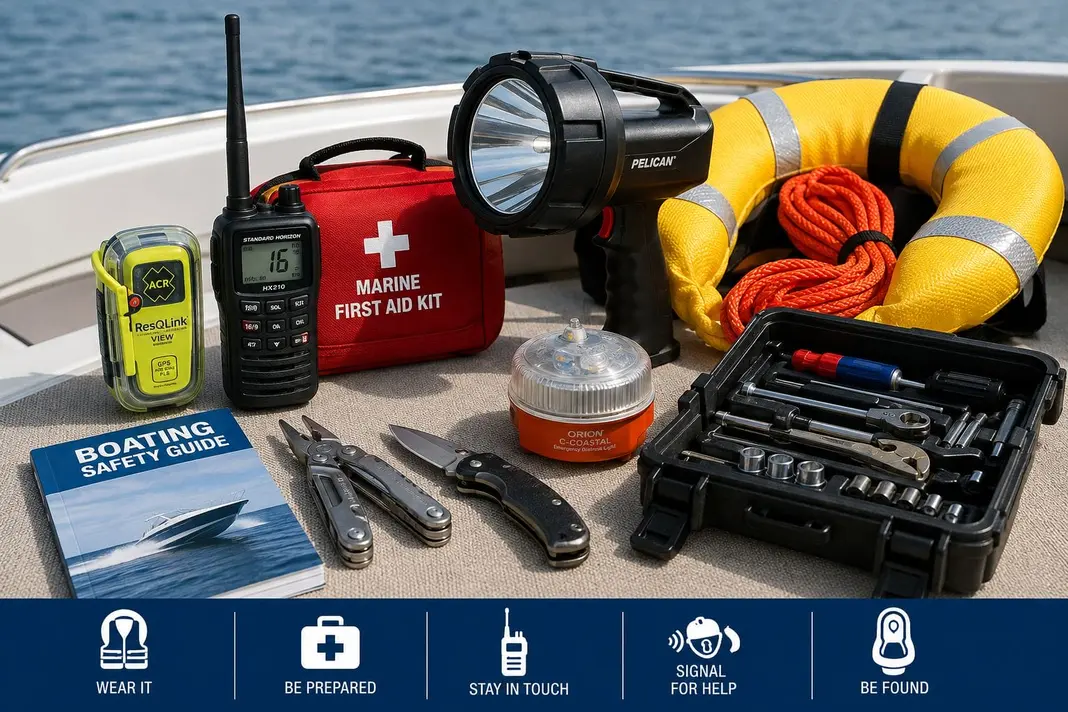
Here are eight safety upgrades that deserve a spot on almost any recreational boat.
1. A Wearable Life Jacket You’ll Actually Wear
Having enough life jackets aboard is important. Wearing them is even better.
The Coast Guard requires recreational vessels to have an appropriately sized, U.S. Coast Guard-approved wearable PFD for each person aboard. The Coast Guard also points out that the best life jacket is ultimately one you’ll actually wear.
For adults who don’t like bulky traditional life jackets, an inflatable PFD can be a good option for appropriate activities and users. They’re lightweight enough to wear while fishing, cruising or working around the boat without constantly getting in the way.
Whatever style you choose, check the label to make sure it’s Coast Guard approved and appropriate for the activity. Inflatable models also need periodic inspection and maintenance.
2. Waterproof Marine First-Aid Kit
Cuts, hooks, burns, falls and other minor injuries have a way of becoming more complicated when you’re miles from the dock.
A good marine first-aid kit should include more than a handful of adhesive bandages. Look for gauze, antiseptic supplies, medical tape, burn treatment, gloves, scissors and supplies for controlling bleeding.
Just as important is the case. A waterproof or water-resistant hard case helps protect everything from spray, rain and the generally damp environment found aboard a boat.
Amazon carries everything from inexpensive compact kits to much more extensive marine medical kits. Choose one based on the number of people normally aboard and how far you typically travel from shore.
3. Rechargeable Waterproof Spotlight
A flashlight is one of those pieces of equipment you may rarely use—until you really need it.
A powerful waterproof spotlight can help identify channel markers, illuminate something floating in the water, inspect the engine compartment or help locate a person in the water after dark.
Look for a rechargeable model with a waterproof rating and enough battery capacity to operate for several hours. A floating design is another worthwhile feature.
We also like keeping a smaller waterproof flashlight aboard as a backup. Electronics fail, batteries die and flashlights have an uncanny ability to disappear exactly when they’re needed.
4. Handheld VHF Marine Radio
Your phone is useful aboard a boat, but it shouldn’t be your only means of communication.
A handheld VHF gives you another way to communicate with nearby vessels, marinas and rescue authorities. It’s particularly useful if the boat’s electrical system fails and your permanently installed VHF goes down with it.
The Coast Guard specifically notes that its boating safety app isn’t intended to replace a marine VHF radio and strongly recommends that boaters carry one.
For boating use, look for a floating, waterproof handheld VHF with a good battery life. Keep it charged and stored somewhere that can be reached quickly.
5. Electronic Visual Distress Signal
Traditional pyrotechnic flares remain common aboard boats, but electronic visual distress signals have become another option.
Certain Coast Guard-approved electronic visual distress signals can satisfy nighttime carriage requirements when used as specified, while also offering advantages such as replaceable batteries and no burning pyrotechnics. Make sure any device you’re relying on for regulatory compliance is specifically approved for that purpose and that you still carry the required daytime signaling equipment for your boat and operating area.
Visual distress signal requirements vary depending on where and how a vessel operates, so boaters should verify exactly what their vessel is required to carry.
6. Throwable Flotation Device With Rescue Line
A throwable flotation device isn’t particularly useful if it’s buried underneath six dock lines, a cooler and three bags of fishing gear.
Keep yours immediately accessible.
The Coast Guard specifically says throwable devices should be immediately available for use. Adding a floating rescue line can make the setup even more useful by allowing you to pull someone toward the boat rather than maneuvering the vessel directly alongside them.
It’s a simple piece of equipment that can be especially valuable when boating with children, older passengers or inexperienced swimmers.
7. Emergency Marine Tool Kit
Not every boating emergency involves calling for rescue.
Sometimes the problem is a loose battery terminal, blown fuse, hose clamp, fouled propeller or another relatively simple mechanical issue.
A compact onboard tool kit containing pliers, screwdrivers, adjustable wrenches, a knife, electrical tape, spare fuses, zip ties and a multitool can solve a surprising number of problems.
Keep the kit in a waterproof box and customize it for your boat. Spare fuses, bulbs, hose clamps and other boat-specific items can be much more useful than carrying 100 tools you’ll never need.
8. Personal Locator Beacon for Offshore Boaters
For boaters regularly traveling offshore or into remote areas, a Personal Locator Beacon can be one of the most important additions to your safety equipment.
A PLB is registered to an individual and, when activated, transmits a distress alert through the satellite-based search-and-rescue system. Unlike a piece of equipment permanently mounted to the boat, a PLB can be worn on your person.
That distinction matters if you become separated from the vessel.
PLBs and EPIRBs should be properly registered and registration information kept current. The Coast Guard directs beacon owners to NOAA’s beacon registration system for registration and updates.
Safety Gear Only Works If You Can Reach It
Buying safety equipment is the easy part. Where you put it matters just as much.
Life jackets shouldn’t be buried in inaccessible compartments. The first-aid kit shouldn’t be underneath the tackle boxes. Your handheld VHF shouldn’t have a dead battery, and emergency signaling equipment shouldn’t be forgotten in a compartment for five years.
At the beginning of the season—and periodically throughout it—take a few minutes to inspect your safety equipment. Check batteries, expiration dates, life jackets, fire extinguishers, first-aid supplies and signaling equipment.
You can also request a free Vessel Safety Check to help verify that your boat has the required equipment aboard.
The goal isn’t to fill the boat with emergency gear. It’s to have a relatively small collection of dependable equipment that you know how to use and can reach immediately when something goes wrong.

